Maize supplies more than 80 percent of dietary calories in Tanzania, and per capita consumption sits between 100 and 135 kg a year.Area harvested runs near 4 million hectares at yields of 1 to 2 tonnes per hectare. Two operating conditions shape entry into this market. Post-harvest losses reach up to 40 percent, affecting the price and quality of grain arriving at the mill gate, and storage is thin at about 286,000 tonnes of national reserve capacity across 30 facilities. Regional comparisons help calibrate the numbers, as shown in the Kenya maize milling business cost and regional maize milling machine pricing.
Investment divides into machinery, civil construction, utilities and power systems, and labour with commissioning. Machinery absorbs 40 to 50 percent of the total, civil work 20 to 25 percent, utilities 10 to 15 percent, and labour with commissioning 5 to 10 percent.
| Category | Share of total investment | Tanzania-specific driver |
|---|---|---|
| Machinery and equipment | 40 to 50 percent | Cleaning depth and degerminator specification |
| Civil construction | 20 to 25 percent | Multi-level building plus grain storage |
| Utilities and power systems | 10 to 15 percent | Transformer, wiring and diesel backup |
| Labour, training and commissioning | 5 to 10 percent | Shift staffing and fortification dosing setup |
Power infrastructure is a separate procurement line specified with the building: a 120 to 160 kVA transformer, three-phase distribution to the mill floor, and a generator sized for milling and conveying. Retro-fitting backup after commissioning costs more than including it. Layout choices that reduce building volume also reduce landed cost, since imported equipment carries clearing and inland transport, as set out in the corn mill layout design and the corn processing plant cost breakdown. A Tanzanian maize line is sized on hourly throughput and on grain quality, not on tonnage alone. Sharing the intended product grade, the incoming moisture and impurity levels, and the available building height allows the configuration to be checked against site conditions before a quotation is issued.Request a Tanzania maize flour mill configuration review

A 20 TPD maize line has five process sections: cleaning, tempering and degermination, roller milling, sifting and packing. Each is sized on hourly throughput rather than daily tonnage, and here the cleaning and degermination sections carry more weight than their cost share suggests.
Cleaning removes sand, stone, metal and light impurity before any kernel breaks, because one stone reaching the rolls damages a chilled pair worth more than the section. Cyclone separators run at 98 percent efficiency and bag filters capture to 5 micron, holding total capture at 99.8 percent or above. Where incoming grain carries a heavy impurity load, a two-deck destoner with an aspiration channel is not optional, and the sequence appears in the complete maize flour milling process.
The degerminator splits the tempered kernel into pericarp, endosperm and germ, and it also determines how much contamination reaches the finished product. Published configurations reach 98 percent dehulling efficiency, and well-separated grits hold fat below 1 percent. Because aflatoxin risk in Tanzanian maize is real, cleaning and aspiration matter commercially and not only technically: removing fines, broken kernels and dust reduces the load later testing has to clear. The process logic appears in the corn milling process.
Roller milling reduces endosperm across a sequence of breaks and reductions, with sifting classifying stock between passages. Roll gap, speed differential and sieve aperture set the split, and a tempering-degerming system typically recovers 12 percent flaking grits, 15 percent coarse grits, 23 percent medium grits, 23 percent fine grits, 10 percent coarse meal, 10 percent fine meal and 5 percent flour by weight. Which fractions the market wants is a commercial question to settle before the flow sheet is fixed.
Packing converts tonnage into bags, and 800 bags a day makes the packing line a production constraint. Weighing and dosing calibrated to plus or minus 1 percent keep declared weight compliant, and automated palletising lifts throughput by 25 percent where one operator covers the shift. Fortification adds a dosing step ahead of the packer and is a compliance requirement rather than an option: the Tanzania Bureau of Standards sets the fortified milled maize specification under TZS 328, and fortification regulations make enrichment of maize flour mandatory. Equipment options appear under the automatic flour packaging machine range.
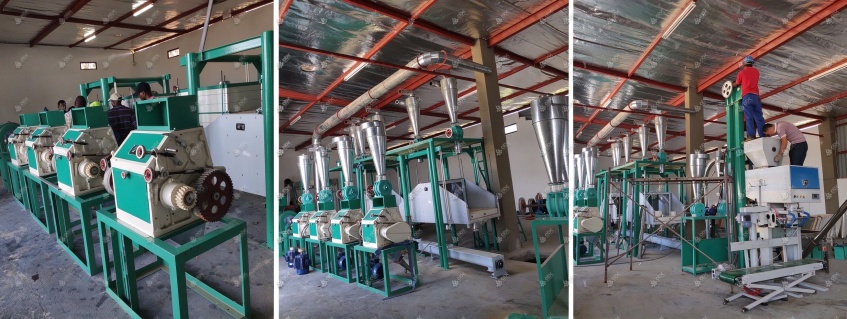
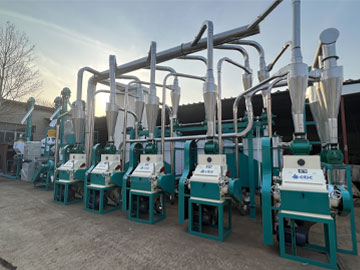
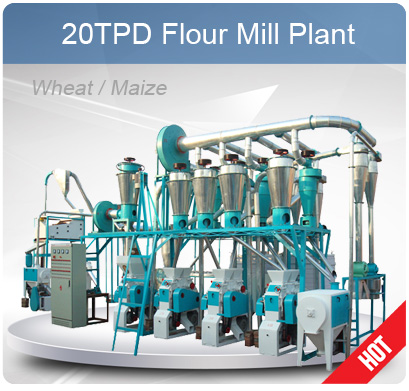
20 TPD Maize Flour Mill Equipment in Tanzania
Payback equals total investment divided by annual net profit, and the denominator is where most models fail. Annual net profit depends on extraction rate, raw material cost, finished product price and operating cost per tonne, and in Tanzania the raw material line moves further than in most markets.
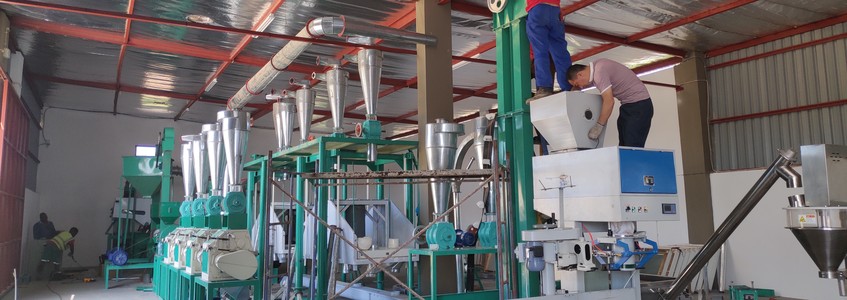
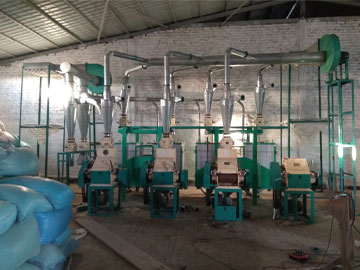
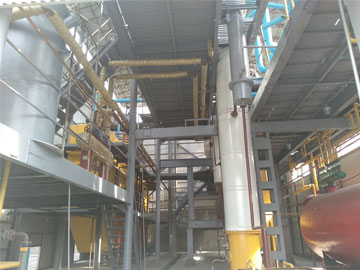
Maize Flour Mill Production Equipment Installation Site
| Variable | Where the figure has to come from | Tanzania planning note |
|---|---|---|
| Extraction rate | Test milling of the buyer's own maize | 65 to 72 percent, lower where impurity is high |
| Raw material cost | Regional market survey across the season | Swings with rainfall and export permits |
| Finished product price | Wholesale survey in the target districts | By grade and by pack size |
| Operating cost | Energy, labour and spares per tonne | 60 to 80 kWh per tonne plus labour |
Published analysis for modern corn mills reports payback within 2.5 to 3 years at gross margins of 25 to 30 percent, and that band holds only where the four variables are measured locally, as set out in the corn milling industry profitability review. Operating expenditure typically splits 50 percent raw material, 25 percent energy and 15 percent labour, making energy the only line a mill can move after commissioning.
The sensitivity that matters most here is the raw material line, not the equipment line. A strong harvest lowers input cost and shortens payback, while a tight season and export restrictions reverse it within a single year. Extraction compounds the effect: five percentage points lost removes roughly 7 percent of saleable output while the grain bill stays unchanged. A two to four week grain buffer is therefore a payback decision, and the sizing appears in the 10 to 20 TPD maize milling plant specification.
The decisions above are engineering decisions made against a specific market, and the supplier's role is to hold them together from layout through commissioning. The five points below decide whether a line reaches rated throughput after handover rather than settling at a fraction of it.
Complete line supply from cleaning through packing, so cleaning depth, degerminator and roller mills are matched to Tanzanian grain conditions rather than to a generic specification, following the complete corn mill setup guide sequence.
Layout support based on the actual plot, including gravity flow where building height permits, which is where the 8 to 10 percent power saving is won or lost.
Fortification dosing integrated ahead of the packer, so the line meets TZS 328 and the fortification regulations without a retrofit.
Commissioning and operator training on the installed line, with test milling used to establish the extraction rate the payback model depends on.
Reference installations across East Africa in the 10 to 100 TPD band, including a maize flour plant in Uganda and a maize and corn mill project in South Africa.
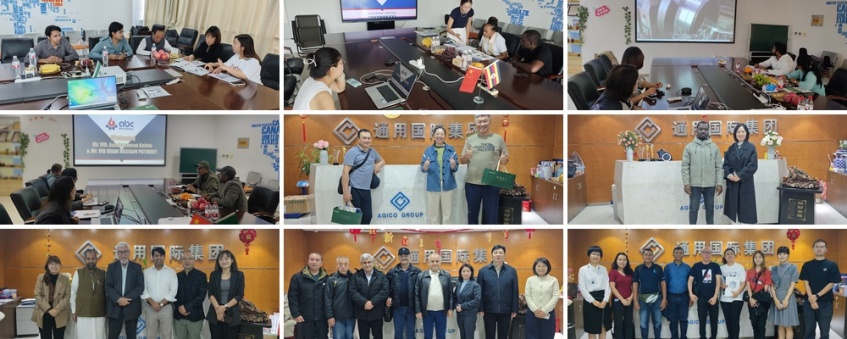
Global Flour Milling Machine Investors Visiting ABC Machinery
Figures in this article are planning references drawn from published statistics, equipment specifications and engineering guidance. Final throughput, extraction and energy consumption are confirmed by test milling of the buyer's own grain and by site measurement.

ABC Machinery built a complete 100 TPD soy protein isolate line in Uzbekistan: pretreatment, low-temperature extraction, purification and spray drying....
Recently, the mayor of a city in Zimbabwe visited a local maize processing plant project. The plant is the latest cooperation project between ABC Machinery and our Zimbabwean client. All the highly efficient maize mill machines for the maiz...
Zambia 2024 is coming up with AGRITECH EXPO ZAMBIA exhibition at GART Research Centre, Chisamba (April 18th to April 20th) . ABC Machinery will be participating in this years Exhibition. We cordially invite you to visit our booth (A19) and...